Zimplix.
Editable websites with the speed of a static site.
The challenge.
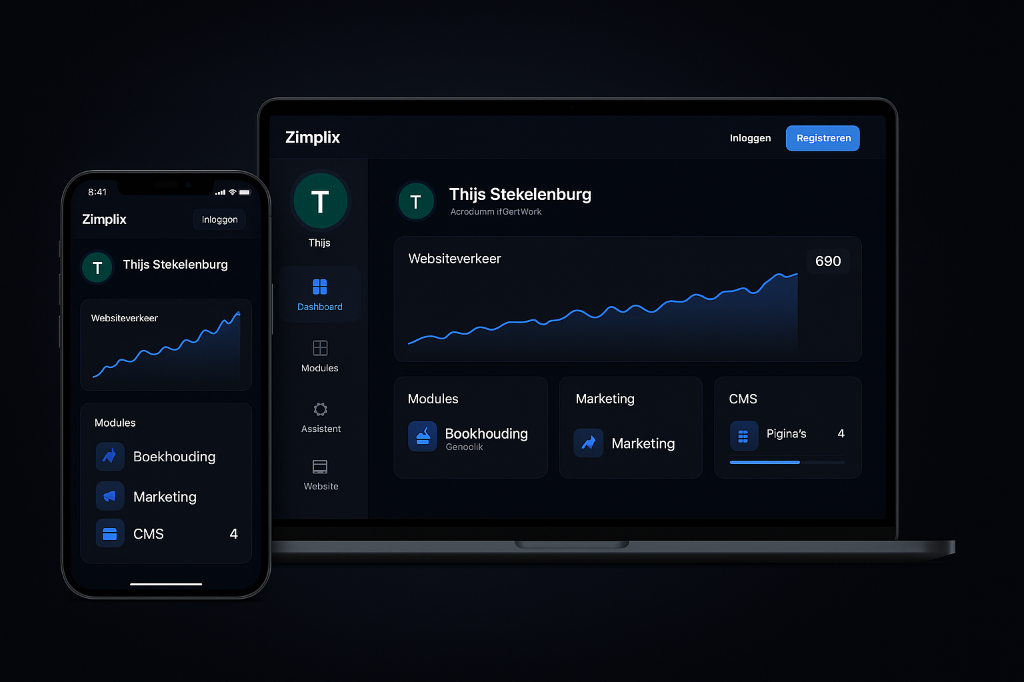
Zimplix started with a technical question: why should a website that consists mostly of fixed content depend on a backend and database for every visit? I wanted to explore a different approach. My idea was to make content easy to edit through a small CMS while keeping the published website fully static. An administrator could change some text or a blog post, after which Zimplix would rebuild and publish the website. Visitors would only receive the generated HTML, CSS and JavaScript. No additional content would need to be fetched from a backend while the page loads. Besides improving speed, this reduces the public website's attack surface: normal browsing does not require visitors to access a database connection or application backend directly. The aim was to combine the ease of use of a CMS with the speed, simplicity and security of a static website.
From challenge to software.
My idea was to combine the advantages of both approaches. Content is edited through a simple content manager, but visitors do not use a dynamic backend. Whenever text or a blog post changes, a compiler rebuilds the website as static HTML, CSS and JavaScript. The new version can then be published immediately.
My role
I developed the concept from this architectural idea and then worked it out in detail.
Key features
- Editing content without working directly in the source code
- Generating static pages after every change
- No database requests during normal browsing
- Storing content in structured models
- An automated build and publishing process
Connecting the parts.
Content is stored centrally while a website is being managed. When something changes, the compiler combines the content and templates into a new static version of the website. Visitors therefore do not need to fetch additional content from an API or database while a page loads.
- Zimplix Content Manager
- FastAPI Backend
- Content Database
- JSON Content Model
- Static Website Compiler
- Generated Website
Technical challenges
SEO was an important design consideration. When pages are built from a management system, URLs, metadata, headings, internal links and indexable content all need to be included correctly in the generated HTML. The project was therefore about more than speed: it was also about how the compiler could generate technically sound, search-friendly pages.
What I learned.
Zimplix taught me to look beyond simply building features. I had to think about architecture, performance, caching, SEO, content models and everything that happens between someone editing content and the resulting website going live.